
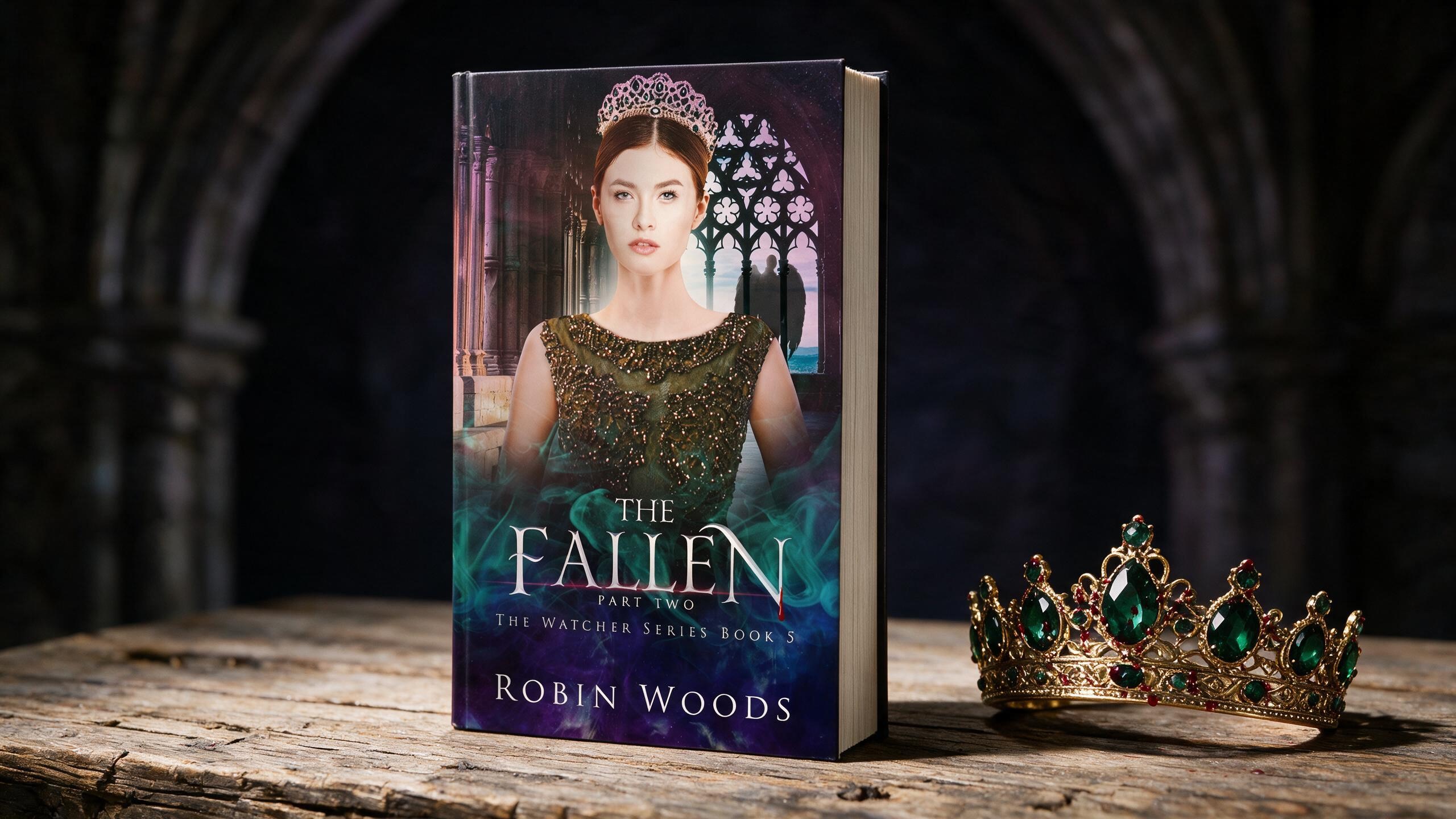
The Watcher Series, Book Five
Betrayal changes everything.
Aleria “Ali” Hayes has survived captivity, prophecy, vampires, fallen angels, and more than one person deciding they knew what was best for her.
But some wounds cut deeper than others. After a betrayal shatters her trust, Ali pulls away from the Watchers and finds herself even more deeply entangled in the endgame of the Fallen.
Her visions are changing. The French Coven is beginning to fracture. Old enemies are becoming necessary allies. And the fragile cooperation holding vampires and humans on the same side may not survive what comes next.
The final battle is no longer somewhere in the future. It has already begun.
When Trust Breaks
Ali has spent most of the series trying to determine whom she can trust. In The Fallen, Part Two, that question becomes painfully personal. Betrayal forces her to reconsider people, relationships, and institutions she once relied on.
Walking away may create distance. It doesn’t create safety. The supernatural conflict continues moving around her, and everyone seems to want something. From Ali. From the Coven. From the Watchers. From the future itself.
The problem with losing trust is that danger does not politely wait while you decide whom to believe next.
If You Like…
You may enjoy The Fallen, Part Two if you like:
- Fallen angels
- Betrayal and damaged trust
- Alliances held together by paperclips and wishful thinking
- Vampire politics
- Mutiny and shifting loyalties
- Prophecy that refuses to behave
- Ancient evil with terrible timing
- Secret investigations
- Found family
- Redemption
- Apocalyptic stakes and deeply inconvenient feelings

Myth, Prophecy & a Future That Won’t Sit Still
Ali’s visions have never been convenient. They arrive in fragments. Images. Warnings. Pain. Pieces she has to understand after the fact.
In The Fallen, Part Two, something changes.
The visions become more invasive and difficult to interpret, and even the people studying them are unsure what that change means. The Watchers are left asking whether Ali is simply seeing more clearly or whether something else is reaching into the process.
Meanwhile, ancient objects and old prophecies continue pulling the conflict toward a future no one fully understands. The mythology that began with old books and forgotten names is no longer theoretical.
It is happening.
Mythological threads to watch for:
Semjâzâ
An ancient name has moved from the margins of old texts toward the center of the approaching conflict. How much he wants, and how far he is willing to go to get it, remains dangerously unclear.
The Fallen
They are ancient, powerful, and considerably more complicated than a single unified enemy.
Visions
Ali’s ability continues to change, raising uncomfortable questions about what she sees, why she sees it, and whether every vision can be trusted.
Ancient artifacts
The pieces still in play are no longer merely historical curiosities. They are leverage. And everyone seems to understand that.
Whoever controls the past may have far too much influence over what comes next.
A Kingdom Built on Unsteady Ground
The French Coven has changed. So has the balance of power surrounding it. Leadership that once seemed absolute is now vulnerable to ambition, resentment, old loyalties, and people who believe they could make better use of the throne.
As unrest grows, the consequences reach far beyond vampire politics. People who have never trusted one another will have to trust in order to survive.
That is difficult on the best of days. These are not the best of days.
When supernatural politics begin to fracture during an approaching war, timing becomes unfortunate in the extreme.
Two Sides of the Watchers
The Watchers are supposed to stand together. Ian and Phineas show how complicated that idea can become.
Both men belong to the organization. Both believe their actions matter. But they represent very different ideas of what serving the Watchers actually means.
One is willing to chase answers wherever they lead. The other understands the power of hierarchy, information, and control. As pressure builds inside the organization, that difference becomes increasingly important.
Because protecting an institution and protecting the people inside it are not always the same thing.

Meet Ian & Phineas
Ian is not an ancient being. He doesn’t command armies. He doesn’t need to. What Ian brings is intelligence, humor, adaptability, and a willingness to get involved even when being involved is a spectacularly bad idea.
He follows leads. He uses technology. He talks his way into places he probably shouldn’t be. All while using well-deployed charm. And he remains fiercely loyal to the people he considers family.
Phineas represents something different. He is more deeply connected to the Watcher hierarchy and to the systems that determine who knows what.
He has experience. Authority. Access. And increasingly, questions seem to gather around him.
Ian searches for information from the outside. Phineas sits much closer to the center. Both men represent the Watchers. But they don’t represent the same version of them.
Ian asks: What needs to be done?
Phineas asks: Who has the right to decide?
And somewhere between those questions lies one of the central tensions of The Fallen, Part Two.
When Information Becomes a Weapon
The war is not being fought only with blades, supernatural strength, and ancient artifacts.
Information matters too.
- Who knows Ali’s location?
- Who understands the artifacts?
- Who has access to sealed files?
- Who can be trusted with information?
The Watchers begin following a trail that raises increasingly uncomfortable questions about how much information has escaped their control.
Every answer creates another question. And when secrets become dangerous enough, keeping them may feel like protection. Until someone else pays the price.

When Alliances Become Necessary
By this point, nearly everyone has history with everyone else. Usually violent history. Watchers. Vampires. Fallen. Families. Covens. Ancient enemies. Recent enemies. People who were allies until approximately five minutes ago.
The world of The Fallen, Part Two is held together by agreements that are fragile even on a good day. And this is not a good day. Survival requires people to decide which grudges still matter, which loyalties can bend, and which lines they refuse to cross.
An alliance does not necessarily mean trust.
Sometimes it simply means: I dislike you slightly less than the person currently trying to kill us both.
Progress.
Who Are You Without the People Who Defined You?
Throughout the Watcher Series, other people have tried to tell Ali what she is. Human. Seer. Watcher. Vampire. Nexus. Weapon. Symbol. Threat. Hope.
By the final book, those definitions have accumulated until they threaten to become another kind of cage. Ali has changed dramatically since the girl who wanted to survive finals and repair her grades in The Unintended.
But the central question remains surprisingly familiar: Who gets to decide who she becomes?
The answer matters more now because Ali possesses power she didn’t once understand. And power makes self-knowledge considerably less optional.
The Difference Between Mercy and Weakness
War has a way of making compassion look impractical. Characters in The Fallen, Part Two repeatedly face choices where mercy creates risk and cruelty appears efficient.
That does not make cruelty right. It simply makes the decision harder.
This book asks: What does strength actually look like? Especially when destroying someone would be much easier than understanding them.
Is mercy weakness? Or does it require a kind of strength violence does not?
The answer depends very much on whom you ask.

The Endgame
Everything has been moving toward this. The Watchers. The French Coven. The Fallen. The visions. The artifacts. The relationships Ali has fought for, damaged, lost, repaired, and refused to abandon.
By The Fallen, Part Two, every choice carries more weight because there is less room left for another attempt.
The future is converging.
And Ali is no longer standing at the edge of the conflict.
She is standing inside it.
Book Club Discussion Questions
Spoiler Warning
The questions below are intended for readers who have finished The Fallen, Part Two. Major plot points are discussed.
- How does betrayal affect Ali’s ability to judge whom she can trust?
- Ali separates herself from the Watchers after her trust is damaged. Do you think she needed that distance in order to understand herself more clearly?
- Throughout the series, people repeatedly make choices for Ali because they believe they are protecting her. Which characters understand the difference between protection and control by the end?
- Ali’s visions change significantly in this book. How does that change her relationship with her abilities?
- The French Coven faces internal division at the worst possible time. What does that conflict reveal about leadership, ambition, and loyalty?
- Several characters cooperate with people they once considered enemies. Which alliance surprised you most?
- Does necessity create genuine trust, or merely temporary cooperation?
- Ian contributes to the conflict through surveillance, investigation, technology, and loyalty rather than supernatural power. What does his role say about different kinds of strength?
- Phineas occupies a position of trust within the Watchers. How does his storyline challenge the assumption that belonging to the “right” organization makes someone trustworthy?
- Ian and Phineas represent two different approaches to serving the Watchers. Which approach do you think the organization needs most?
- When does loyalty to an institution become dangerous?
- How does secrecy operate in this novel? Are there situations where withholding the truth is justified?
- The series repeatedly asks whether someone’s nature determines their morality. How would you answer that question after finishing the final novel?
- How does the book use the idea of mercy? When does mercy become strength, and when can it become dangerous?
- By this point, Ali has been given many identities by other people. Which identity do you think she ultimately claims for herself?
- The series began with the question of fate versus free will. After five books, do you think Ali fulfills a destiny or creates one?
- Which relationship ultimately has the greatest influence on the person Ali becomes?
- Looking back to The Unintended, what part of Ali’s original personality remains most intact despite everything she has experienced?
- What does “fallen” mean to you by the end of the series? Does it apply only to angels?
- Did the ending change the way you interpret any earlier event, prophecy, or relationship in the series?
One Last Question
After everything Ali has learned about fate, prophecy, trust, and choice:
Would you still want to know your future?
The Story Continues
Not Quite Ready to Leave the Shadow World?
The main Watcher Series story may be complete, but some stories refuse to stay neatly inside the novels.
Light & Shadow collects short stories, alternate perspectives, deleted material, artwork, poems, and scenes that explore familiar characters and moments from different angles.
See what happened outside Ali’s point of view.
Revisit familiar moments.
Discover a few things the main books never had room to tell you.

And if you want to step backward in time before leaving the shadow world: