
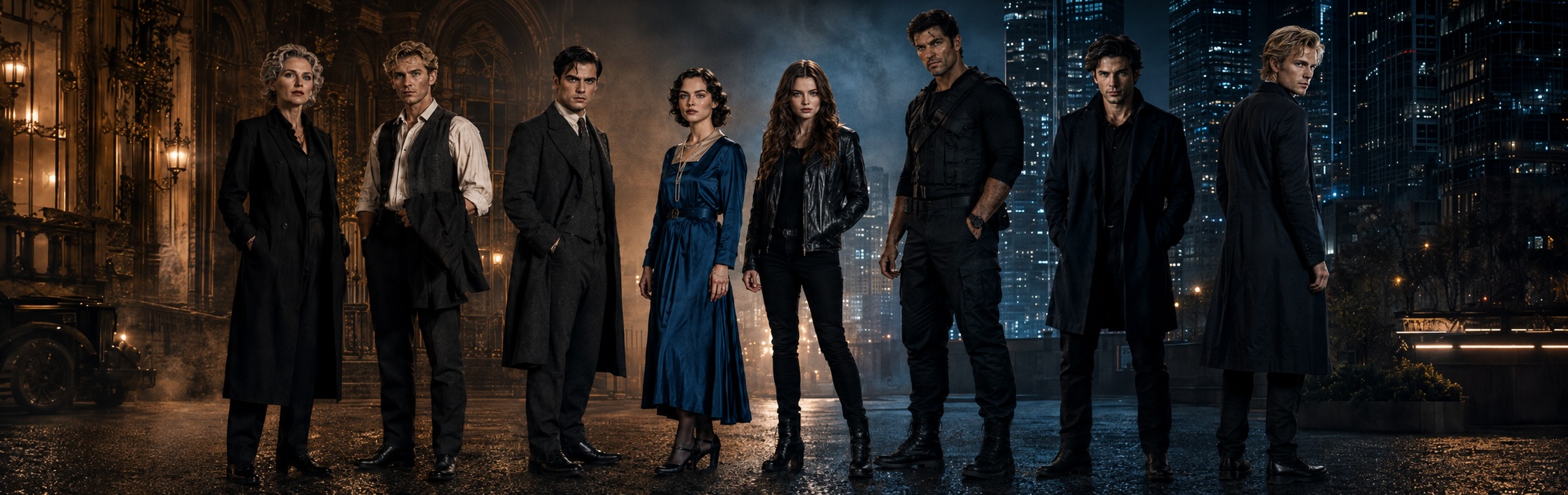
A Behind-the-Scenes Look at the Watcher Series
Vampires. Watchers. Slayers. Fallen angels. Ancient bloodlines. Prophecies that refuse to mind their own business.
The Watcher Series grew into a much larger world than I imagined when I first began writing it. Over the years, readers have asked about…well, pretty much everything.
So consider this your invitation backstage.
Some of what follows comes directly from the world of the books. Some comes from the research and ideas behind them. And some exists simply because I spent far too much time thinking about fictional people.
Spoiler Warning: This page reaches across the entire Watcher Series. I’ll try not to ruin all the surprises, but readers who want to remain completely unspoiled should finish The Fallen, Part Two first.
Meet the Characters
There are a lot of people wandering around the shadow world. Some protect humanity. Some would very much like to eat it. Some have been alive long enough to know better and continue making terrible decisions anyway.
Here are a few of the faces from The Watcher Series.


The Watchers
Character portraits are visual interpretations created for the Watcher Series. See Art & Image Credits for more info.
The Watchers exist to protect humanity from supernatural threats while remaining largely invisible to the human world. But “Watcher” is not a single job.
The organization includes field Watchers, Slayers, Keepers, leaders, strategists, assets, councils, and others working within a much larger structure known as the Concilium of the Watchers.
And, as anyone who has read the books knows, having an organization dedicated to protecting humanity does not guarantee that everyone within it will agree about how that should be done. Sometimes very loudly.
The Concilium
The Concilium is the larger organization governing the Watchers.
Its structure developed over centuries and includes different branches of authority, including the Council and Conclave. Watchers operate within that system in a variety of roles, while Slayers serve as some of its most formidable protectors.
The Council


Want the detailed version?
The complete Watcher hierarchy and explanation of the Concilium also appear in Light & Shadow.
Watchers & Slayers
They work toward the same larger goal, but they are not the same thing.
Watchers
Watchers live and work throughout the human world. They observe, investigate, gather information, develop connections, and help protect humanity from threats most people never know exist.
Different Watchers develop different strengths. Some are fighters. Some are scholars. Some are investigators, strategists, linguists, or experts in moving unnoticed through the human world.


Slayers
Slayers are trained specifically for combat against supernatural threats. They are among the most dangerous members of the Concilium and are generally sent where ordinary intervention is no longer enough.


The Slayer Tattoo
The tattoo incorporates the ideals and responsibilities carried by the Slayers, including:

Vitae — life
Veritas — truth
Aeternitatis — eternity
Custodite próxima et futura — preserve the past and future
It is more than decoration. It identifies a Slayer and connects that individual to a history far older than the events of the novels.
The French Coven
The Watchers are only one side of the supernatural world.
The French Coven is one of the oldest and most powerful vampire organizations in the series, with its own history, hierarchy, alliances, rivalries, and traditions.
Its members have existed across centuries of human history, sometimes hiding within it and sometimes influencing events from the shadows.
At the center of much of the early conflict is a family whose history stretches back to a time when humans treated immortals as gods. Which, unsurprisingly, did very little for anyone’s ego.


The Oneiroi
This set of brothers has a very special ability, besides looking a lot alike. You will love to hate this trio.


The crest appears throughout the world surrounding the French Coven and represents its history and authority. The original crest artwork was illustrated by Vera Walker.
The Lux Casta
The Lux Casta are an ancient bloodline of Seers.
Their abilities allow them to glimpse events beyond ordinary perception, though visions rarely arrive with convenient instructions explaining what they mean.
By the twentieth century, the Lux are believed to have nearly disappeared.
Allure steps backward into that history through Rosemond Le Clair, while the main Watcher Series slowly reveals why the bloodline still matters.
And why certain people are willing to do almost anything to find it.

The Fallen
Long before vampires and Watchers began fighting one another, another conflict had already shaped the supernatural world.
The mythology of the Watcher Series reaches into stories of fallen angels, rebellion, the Nephilim, ancient prophecy, and beings whose history has been distorted into fragments of religion, mythology, folklore, and literature.
Names that initially appear to belong safely inside old books eventually become considerably less theoretical.
By the later novels, the question is no longer whether those old stories contain truth.
The question is what happens when that truth comes back.

Symbols in the Shadow World
Symbols appear throughout the Watcher Series, sometimes quietly and sometimes as part of the larger mythology.
The North Star
The North Star becomes a recurring personal symbol, associated with guidance, constancy, memory, and finding a way home.
Angels
Angelic names and imagery run throughout the series, but the distinction between angel, Fallen, Slayer, and the stories humans tell about them is not always as simple as it first appears.

Literature Behind the Watcher Series
Literature isn’t just decoration in these books.
The characters read it, argue about it, recognize themselves in it, misunderstand it, and occasionally discover that something they thought was literature may be considerably closer to history.
Some of the works and writers woven into the series include:
The Tempest — William Shakespeare
One of the earliest questions behind The Unintended was essentially:
What if Caliban had been beautiful?
Beauty and monstrosity are not necessarily opposites in the Watcher world, and appearances are rarely reliable evidence of goodness.
The Great Gatsby — F. Scott Fitzgerald
Ali’s thoughts about Gatsby, devotion, romantic idealism, and loving someone who may not deserve it quietly echo larger questions that follow her throughout the series.
Paradise Lost — John Milton
What begins as literature becomes increasingly relevant as Ali learns more about the history of the Fallen.
Ancient names stop feeling quite so ancient.
The Book of Enoch
The mythology surrounding the Watchers, fallen angels, and ancient rebellion was one of the important sources that helped shape the supernatural foundation of the series.
Rainer Maria Rilke
Rilke’s writing, particularly Letters to a Young Poet, influenced some of the literary material woven through the early books.
Poetry
Shakespeare, Browning, Rilke, and other writers appear throughout the books, while original poetry became another way for me to explore the emotional lives of my own characters.

Where the Watcher Series Began
The earliest version of the Watcher Series began in 1996.
At the time, I was teaching English to high-school juniors, so I made my protagonist the same age as my students. Because she didn’t have decades of life experience to draw upon, I gave her something I knew very well: Literature.
The books and mythology I was immersed in became part of the way Ali understood the increasingly strange world around her.
I had recently earned my English degree, so mythology and literature were still very much living in my brain. Paradise Lost, The Book of Enoch, Dracula, and The Tempest all helped feed the developing mythology.
A friend also introduced me to Highlander. And apparently my brain decided that was exactly the ingredient the mixture needed.
I didn’t finish the novel then. I wrote scenes, chose names, built characters, and created pieces of the world before putting the manuscript away. Years later, I returned to it.
Then one of my students spotted the manuscript and asked if she could read it. I reluctantly said yes. Then she asked if she could take it home so she could finish it.
That changed everything.
I started writing seriously again, and The Watcher Series grew from the fragments of that old manuscript into the world you see now.
Some Scenes Are Older Than You Think
A handful of scenes in The Unintended trace all the way back to that original 1996 version of the story. Among them were early versions of:
- the coffee shop rescue
- the locker confrontation
- the apartment attack
- the caged sequence
- “blink yes or no”
There were also two original opening chapters.
No.
You cannot have them.
Some things are better left buried.
Building the World
Writing the Watcher Series has always involved considerably more than sitting down and typing chapters.
- I research locations (in fact I’ve been to most of them).
- I make maps.
- I sketch buildings.
- I collect visual references.
- I design graphics.
- I make floor plans (see below).
- I build character histories readers may never see.
I research clothing, transportation, mythology, literature, weapons, architecture, and whatever strange subject the story happens to require that week.
Sometimes all of that research results in three words in the finished book.
This is writing.


Researching Allure
Because Allure takes place in 1928, creating Rosemond and George’s world required a different kind of research from the contemporary novels.
Clothing, automobiles, architecture, language, travel, social expectations, and everyday objects all had to belong to their period.
I collected visual research, built location references, and even worked out layouts for places the characters used while on the run (floor plan above).
From Research to Art
Art has always been part of the way I develop stories.
- Sometimes I begin with a photograph.
- Sometimes a sketch.
- Sometimes historical art.
- Sometimes a character portrait or visual concept helps me understand someone before I can fully write them.
Over the years that process has produced maps, character art, promotional pieces, book graphics, symbols, mood pieces, and more than a few projects that took significantly longer than I thought they would.
Many of the visuals throughout the newer Watcher Series pages were created or art-directed by me. Some original series artwork, including the Slayer tattoo and French Coven crest, was commissioned from artist Vera Walker.
Questions Readers Asked
One of the unexpected pleasures of writing the Watcher Series has been discovering what readers wanted to know after the books were finished. Some questions could be answered in a paragraph. Others required an entire story.
- What did Rosemond’s mother say to George?
- What happened to Joshua in Romania?
- How did Gabriel get his scar?
- What was Bowen doing before Ali entered his life?
- What happened outside Ali’s point of view?
Those questions eventually became part of Light & Shadow: The Watcher Series Shorts & Extras.
So if you’ve reached this point and still have questions…Good.
You’re exactly the sort of person that book was made for. And I’m still open for questions.
